Glass Guide
GLASS GUIDE
FOR
HOUSE OWNER
Float glass, tempered glass, and laminated glass each serves different purposes in construction and design. Each type provides unique benefits for different applications.
Float glass is the basic form, known for its clarity and smooth finish.
Tempered glass undergoes a heat treatment process, making it stronger and more resistant to thermal stress; when broken, it shatters into small, safe pieces.
Laminated glass consists of multiple layers of glass bonded with an interlayer, often used for safety and sound insulation; if broken, the interlayer holds the shards together, reducing injury risk.
Double glass, also known as insulated glazing, consists of two glasses panes separated by an air or gas-filled space, providing excellent heat insulation by reducing heat transfer. It helps maintain indoor temperatures, making it energy efficient and reducing heating and cooling costs.
Key Factors Effecting Performance:
- Glass Thickness: Outer panes (4–12 mm) can be laminated/toughened for durability.
- Spacer Width: 12–20 mm (wider gaps improve insulation but may reduce visible light).
- Gas Filling: Argon or krypton improves thermal performance.
- Coatings: Low-E (low-emissivity) or solar-reflective coatings reduce infrared/UV transmission.
On the other hand, laminated glass features multiple glass layers bonded with an interlayer and can incorporate a UV protection film. This laminated structure not only offers enhanced safety by holding shards together when broken but also provides significant sun protection by blocking harmful UV rays, reducing glare, and protecting interiors from sun damage while maintaining decent thermal performance.
Key Factors Effecting Performance:
Laminated glass for heat and sun protection typically ranges from 6.38 mm to 12.76 mm in total thickness, depending on the number of layers and interlayer type. The glass itself is usually 3–10 mm per pane, while the interlayer (PVB, EVA, or SGP) adds 0.38–2.28 mm per layer.
1. Interlayer Type
- Standard PVB (0.38–1.52 mm) – Good for UV blocking (~99%) but moderate solar reflectance.
- Acoustic PVB (thicker, softer) – Better noise reduction, slightly better heat absorption.
- Solar-Control PVB (e.g., Vanceva Solar, Saflex Solar) – Enhanced infrared (IR) rejection.
- EVA (Ethylene-Vinyl Acetate) – Better clarity, used in advanced solar films.
- SGP (SentryGlas Plus) – Stronger, better structural performance.
2. Glass Coatings
- Low-Emissivity (Low-E) coatings – Reduce heat transfer.
- Reflective coatings – Increase solar reflectance (but may affect visibility).
- Tinted glass (bronze, gray, blue, green) – Absorbs more heat than clear glass.
Best Options for Maximum Heat & Sun Protection
- 12.76 mm Laminated Solar Glass (6+6 with solar PVB) – Blocks >70% solar heat.
- Laminated Low-E Glass – Combines thermal insulation + solar rejection.
- Tinted + Reflective Laminates – Further reduces glare and IR penetration.

Acoustic insulation
For acoustic insulation, specialized glass types and configurations are used to reduce sound transmission. The most effective solutions combine laminated glass, thicker panes, and air/gas gaps to dampen noise. Below are common glass types and their typical sizes for soundproofing:
1. Laminated Glass (Best for Acoustic Insulation)
- How it works: A PVB (Polyvinyl Butyral) or acoustic interlayer absorbs sound vibration.
- Common thicknesses:
- 6.38 mm (3 mm glass + 0.38 mm PVB + 3 mm glass) – Basic sound reduction.
- 8.76 mm (4 mm + 0.76 mm PVB + 4 mm) – Better for traffic noise.
- 10.38 mm (5 mm + 0.38 mm PVB + 5 mm) – Good for urban areas.
- 12.76 mm (6 mm + 0.76 mm PVB + 6 mm) – High-performance soundproofing.
- 14.52 mm+ (6 mm + 1.52 mm PVB + 6 mm) – Maximum noise reduction (e.g., airports).
Best for:
Windows near highways, airports, busy streets
Recording studios, home theaters
Office partitions
2. Double Glazing with Acoustic Laminated Glass
- How it works: Combines laminated glass with an air/argon gap to block sound waves.
- Common configurations (Overall Thickness):
- 24 mm (6 mm laminated + 12 mm gap + 6 mm tempered)
- 28–32 mm (6 mm acoustic laminate + 16 mm gap + 6 mm laminated)
- 36–44 mm (8 mm laminate + 20 mm gap + 8 mm laminate) – Best for extreme noise.
Best for:
High-noise environments (city apartments, industrial zones)
Hotels, hospitals
3. Acoustic PVB vs. Standard PVB
- Standard PVB: Reduces noise by ~30–35 dB.
- Acoustic PVB:
- Thicker (0.76–2.28 mm) and softer for better damping.
- Reduces noise by 37–42 dB (up to 50 dB in triple-glazed setups).

Key Tips for Maximum Acoustic Insulation.
Use asymmetrical glass thicknesses (e.g., 6 mm + 10 mm) to disrupt sound waves.
Wider air gaps (16–20 mm) improve performance.

GLAZING
THICKNESS
FOR TOSTEM
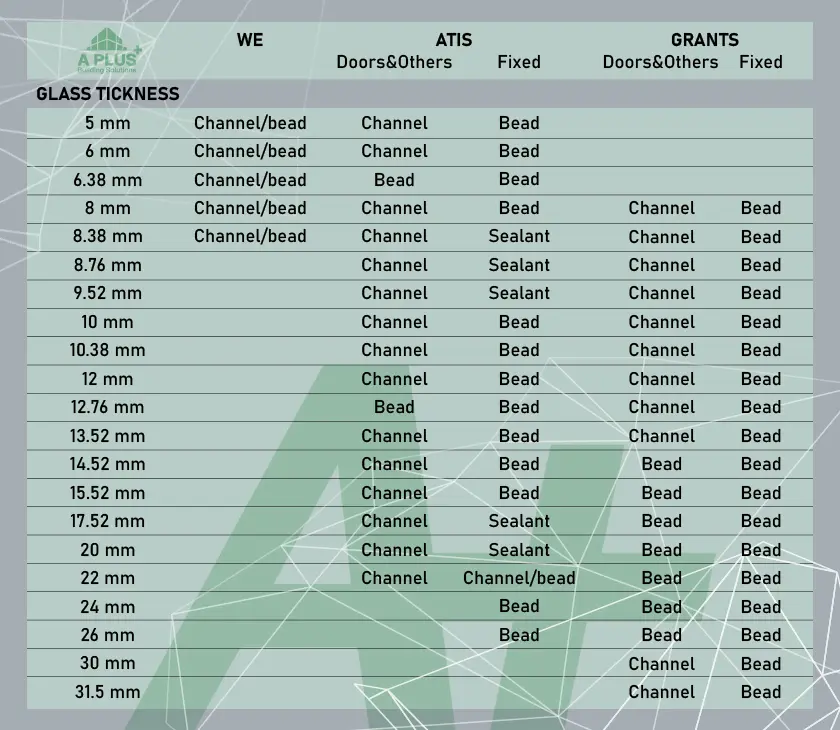
Following glazing thickness can be installed in Tostem windows with a glazing channel (preferred option) or a glazing bead. Other sizes can be installed only with silicon.